Subsea Permitting AI

Every permit your cable needs, in one answer.

A proposed AI agent that lists the permits and authorities for every country your route touches.

Concept preview

Describe the project. Answer a few questions. Get the permits.

You type a short description

The Permitting AgentConcept preview

Describe your cable project

Fibre-optic cable, about 180 km, landing in Cornwall (England) and County Wexford (Ireland). 24 fibre pairs, telecoms only. Route survey planned for spring 2027.

Route, landing points, cable type, timing. Whatever you know so far.

Continue

Why it’s hard

One cable, many jurisdictions, no single rulebook.

A cable between two countries doesn’t just cross a border. It passes through a sequence of maritime zones, and each zone can bring a different authority, a different permit and a different clock.

Landing stationLanding stationLandCountry ATerritorial seato 12 nmEEZ / continental shelfto 200 nmEEZ / continental shelfto 200 nmTerritorial seato 12 nmLandCountry BEach zone can require its own permit from its own authority

Swipe sideways to see the full route.

01

Rules live in scattered places, and go stale

Marine licensing, seabed rights, telecoms authorisation, environmental consent and coastal planning usually sit with different bodies, each with its own guidance. Requirements change, and no single company can keep a verified, cited picture current on its own.

02

Zones change the answer

A coastal state has broad control in its territorial sea, but only limited rights over cables on its continental shelf and in its exclusive economic zone. Knowing where the line falls matters.

03

A combinatorial problem

Every route multiplies coastal states × restrictions × landing options. Screening those combinations by hand is slow, and good options can be missed before a desktop study even starts.

04

Late permits cost a season

A permit discovered late, or one that slips by weeks, can collide with a fixed vessel booking and push a lay window by a season. The earlier the full list is on the table, the cheaper the project.

A cable-laying ship at sea at dawn, its cable drum and stern chute paying cable into the water

The fixed point

The vessel is booked months ahead. The permits have to be there first.

Inside the cable

What’s actually being permitted.

In deep water a telecoms cable is roughly the width of a garden hose. Near the shore, where anchors and fishing gear are a risk, layers of steel armour are added, and that coastal stretch is also where most permits apply.

1234567Typical armoured telecoms cable · simplified, not to scale

Swipe sideways to see the whole cable.

  1. Layer 1: Outer serving. Tar-soaked yarn that binds and protects the armour.

  2. Layer 2: Steel armour wires. Added in shallow water to resist anchors and fishing gear.

  3. Layer 3: Polyethylene insulation. Insulates the conductor and keeps seawater out.

  4. Layer 4: Copper conductor. Carries power to the repeaters that boost the signal along the route.

  5. Layer 5: Steel strength wires. Carry the load while the cable is laid and recovered.

  6. Layer 6: Steel tube. A watertight, gel-filled tube that protects the fibres.

  7. Layer 7: Optical fibres. Hair-thin glass fibres that carry the data, in pairs.

How it would work

Three steps from a description to a permit list.

This is the Permitting Agent: the idea the rest of the proposal builds towards. The AI would do the asking and the matching. The answers would come from a verified rules layer, so every result traces back to its source.

  1. 01

    Describe the project

    Type what you know: the two ends, rough route, cable type and timing. No forms, no jargon required. A sentence or two is enough to start.

  2. 02

    Answer a few questions

    The agent reads your description against the rules layer and asks only for the details that change the outcome, such as whether a landing is new-build or whether the route crosses a third country’s waters.

  3. 03

    Get the permits and authorities

    You receive the permits required in each jurisdiction the cable touches, and the body that issues each one. Every item comes from a verified, cited entry, not a web search.

What you’d get

Required permits, and who issues them.

A structured list you can act on: the permit, what it covers, the issuing authority and the jurisdiction it belongs to.

  • Marine licence

    England

    Laying and burying cable inside 12 nm. Beyond 12 nm laying is exempt, but cable protection or dredging may still need one

    Issued by Marine Management Organisation

  • Seabed rights (lease)

    England

    Occupying the Crown seabed out to 12 nm, and Crown-owned foreshore

    Issued by The Crown Estate

  • Planning permission or prior approval

    England

    Beach manhole, ducts and landing station above mean low water

    Issued by Cornwall Council

  • Maritime Area Consent

    Ireland

    State consent to occupy the maritime area for the cable; needed before applying for planning

    Issued by Maritime Area Regulatory Authority

  • Maritime Usage Licence

    Ireland

    Pre-lay route and seabed surveys

    Issued by Maritime Area Regulatory Authority

  • Planning permission

    Ireland

    Cable works in the maritime area; onshore landing works can be applied for separately

    Issued by An Coimisiún Pleanála (maritime) · Wexford County Council (onshore)

Illustrative and simplified example for Cornwall to Wexford · telecoms cable · new landing in Ireland, current as of September 2026. A full answer would also cover environmental assessments (EIA screening, Habitats / Appropriate Assessment), telecoms authorisation (Ofcom, ComReg), landowner consents such as Duchy of Cornwall foreshore, and crossing agreements with existing cables. Not legal advice.

Per jurisdiction

Results grouped by country and zone, so a two-country cable reads as two clear lists, not one tangle.

Named authorities

Each permit names the body that issues it, so you know who to contact before you start drafting.

Traceable

Every entry carries its source and the date it was last verified. The answer tells you where it came from.

The rules layer

What it would need to cover.

The goal is a shared, verified rules layer for every country with a coastline, across every zone a cable can cross, with the international framework above them. Building it is the hard part, and it’s why we’re asking who wants to help.

Every coastal state
National permitting rules for cable landing and seabed use, country by country.
Every maritime zone
Territorial sea, exclusive economic zone and continental shelf, where the applicable rules differ.
International law
The UN Convention on the Law of the Sea provisions that govern submarine cables, applied alongside national rules.
Curated, not scraped
Entries researched and maintained by people. The AI reads from the rules layer; it never writes to it.

Principles

Whatever gets built, it has to be something a regulator would trust.

Human sign-off, always

No AI output is trusted until a qualified permitting expert has reviewed it. Tools draft; people decide.

Verified and cited

Every rule traces back to its source, with a date. If it can’t be cited, it isn’t used.

Open where it builds trust

Open source and shared schemas where they help regulators, universities and competitors work from the same facts.

Neutral governance

Shared data and tools sit under a neutral structure, so no single vendor controls the industry’s permitting picture.

What the AI would do

  • Understand a plain-language project description
  • Work out which jurisdictions and zones are involved
  • Ask the clarifying questions that change the answer
  • Assemble the matching entries into a readable result

What the AI would not do

  • Invent permits or authorities that aren’t in the rules layer
  • Pull unverified content from the open web
  • Replace a permitting consultant or legal counsel
  • Submit applications on your behalf

The bigger picture

The agent is one of eight ideas.

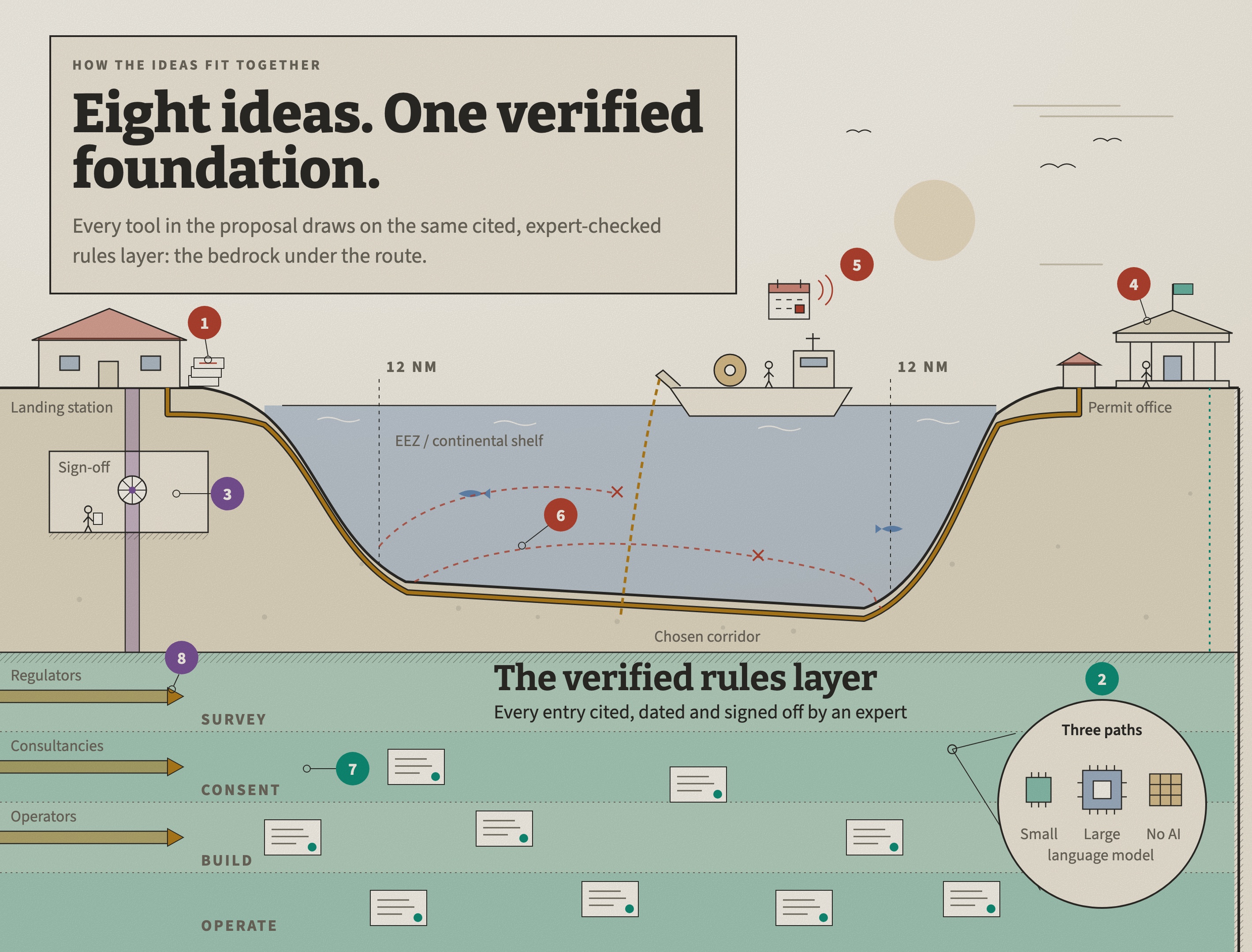
Each one is a tool people would use, a piece of the shared foundation, or the governance that keeps it trustworthy. All of them draw on the same verified rules layer.

Comment on the Proposal →
Cutaway diagram of a subsea cable route from a landing station to a permit office. The verified rules layer is drawn as bedrock beneath the seabed, with eight numbered callouts placing each idea; the numbered list below describes them.

Swipe sideways to see the full diagram, or tap to open it full size. Illustrative diagram of proposed ideas; not to scale. Numbers match the ideas on the comment page.

  1. Idea 1: The Permitting Agent drafts the full permitting package for a route and landing point.

  2. Idea 2: The rules engine is the core of the layer: a small model, a fine-tuned large one, or no model at all.

  3. Idea 3: Expert sign-off. Nothing reaches a user until a qualified person has approved it.

  4. Idea 4: Permit issuance tool. Regulators issue from the same structured data applicants use.

  5. Idea 5: Change alerts flag a slipping permit before it collides with the vessel booking.

  6. Idea 6: Route screening tests candidate corridors and landings, so only viable ones reach a desk study.

  7. Idea 7: Shared taxonomy maps every jurisdiction’s stages onto common categories.

  8. Idea 8: Data consortium. Regulators, consultancies and operators feed corrections in under neutral governance.

  • Tools people use
  • The shared foundation
  • Governance and trust
  • The cable and its route

FAQ

Common questions.

Does this exist yet?
Not yet. The Permitting Agent is a proposal, one of eight ideas that are open for comment. The demo on this page is a concept preview showing how it could work.
Who is this for?
Cable owners and developers scoping a new route, the permitting and legal consultants who advise them, and the regulators who issue the permits. If your work involves working out which approvals a cable needs, it’s built for you.
Where would the answers come from?
From a verified rules layer, not the open web. Each entry would record a permit, the authority that issues it, the jurisdiction and zone it applies to, and the source it was taken from. Which technology that layer should be built on is itself open for comment.
Is this legal advice?
No. It’s a research and planning tool. It would help you see the full picture early, but it doesn’t replace a permitting consultant or legal counsel, and it wouldn’t submit applications for you.
What if my route crosses a country that isn’t covered yet?
The answer would say so explicitly rather than guess. Gaps are flagged, not filled in.
What happens to my feedback?
Ideas and aggregate counts are published for open comment and shared with prospective industry sponsors and university research partners. Your contact details are used only to follow up with you and aren’t published without your permission.
Who is behind this?
OceanJuris, a legal advisory practice specialising in subsea cable regulation and permitting. The proposal launched at Submarine Networks World 2026 in Singapore. oceanjuris.com
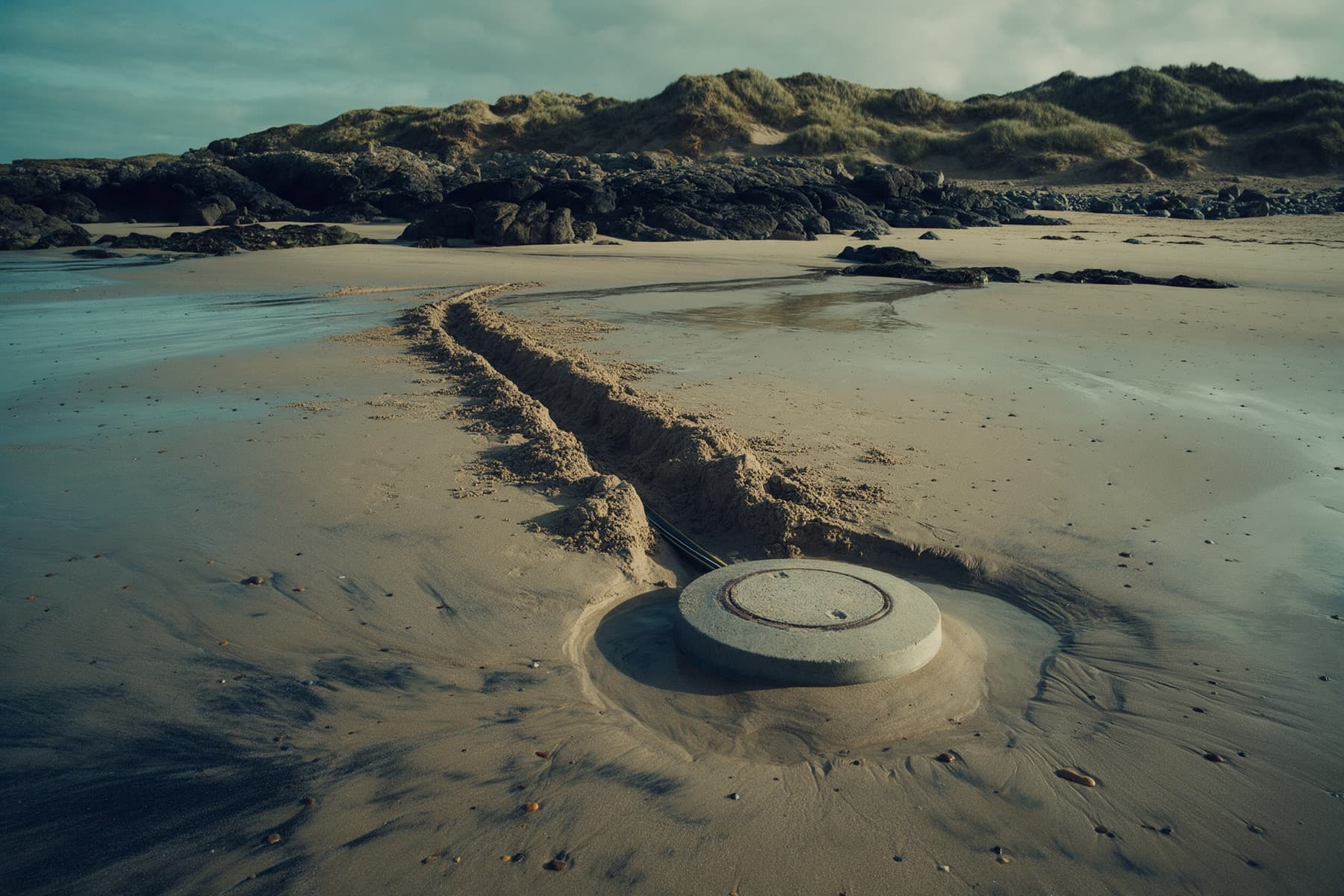
A cable trench crossing a sandy beach at low tide to a concrete beach manhole, with rocks and dunes behind

Compiled by

OceanJuris

OceanJuris provides specialized legal advisory and permitting support for the subsea sector: regulatory advice, risk assessment, and guidance through the permitting process for submarine cable projects. Subsea Permitting AI is an OceanJuris initiative to bring the industry together around the tools it actually needs.

Interested in sponsoring, partnering as a research institution, or joining a working group? Leave your details or visit oceanjuris.com.

Open for comment

Should the industry build this? Tell us — and tell us what else.

Comment on the Proposal →

The Permitting Agent is one of 8 ideas, from a shared rules engine to a verified data consortium. Mark the ones you want to see happen and the ones you’d help build.

Ideas open for comment
8
Respondents so far
0